
Find a Winnebago County Property Owner
A name alone is a weak answer. Build a short record trail instead. Start with the situs address in a Winnebago County parcel or property search. Read the owner field on the tax card next. Copy the PIN and the legal-description clue before you move on. Then compare that owner name to the most recent deed entry in the land-record index. When a deed names a trust or a limited liability company as grantee, a look at the entity record adds context. The land instrument itself is what confirms ownership.
- Search the site address in Ascent, Treasurer TaxSearch, or the GIS Parcel Viewer.
- Write down the parcel number, owner name, mailing address, and legal description.
- Check the latest recorded deed for the grantee and parcel description.
- If an entity holds title, use Wisconsin DFI records to identify its filed agent and status.
Winnebago County Ownership Sources
Ownership information in Winnebago County lives in more than one office. The Real Property Lister and municipal assessors keep the parcel and assessment records. The Register of Deeds holds each recorded deed and other instruments. GIS adds the map layer. A Wisconsin DFI lookup can tell you more about an entity named as grantee. It does not show land title on its own.
| Source | Owner Info It Gives | Access |
|---|---|---|
| Ascent / municipal assessor | Owner field, mailing address, parcel description | Public parcel listing; local links vary |
| Register of Deeds | Grantee and parties on the recorded instrument | Free basic index; images may be paid |
| County GIS | Parcel profile and mapped location | Public viewer |
| Wisconsin DFI | Entity name, status, registered agent, filings | Public business search |
The owner of record may list a mailing address far from the parcel. Neither that field nor the situs address proves who occupies the building. For a transfer question, the latest deed confirms ownership better than a tax-card name alone.
Winnebago County Ascent Owner Fields
A county parcel profile can pack in plenty: parcel number, ownership, mailing address, a short property description, assessed value, and school district, with links to tax, PLSS, zoning, and more detail. The Ascent search is dynamic. Field labels and result columns can vary, and not every municipality shows every field. Treat any single result as a starting point rather than a complete owner dossier. The county's Ascent Land Records Suite ties an address or parcel to real-estate information. It adds tax information in one place too.
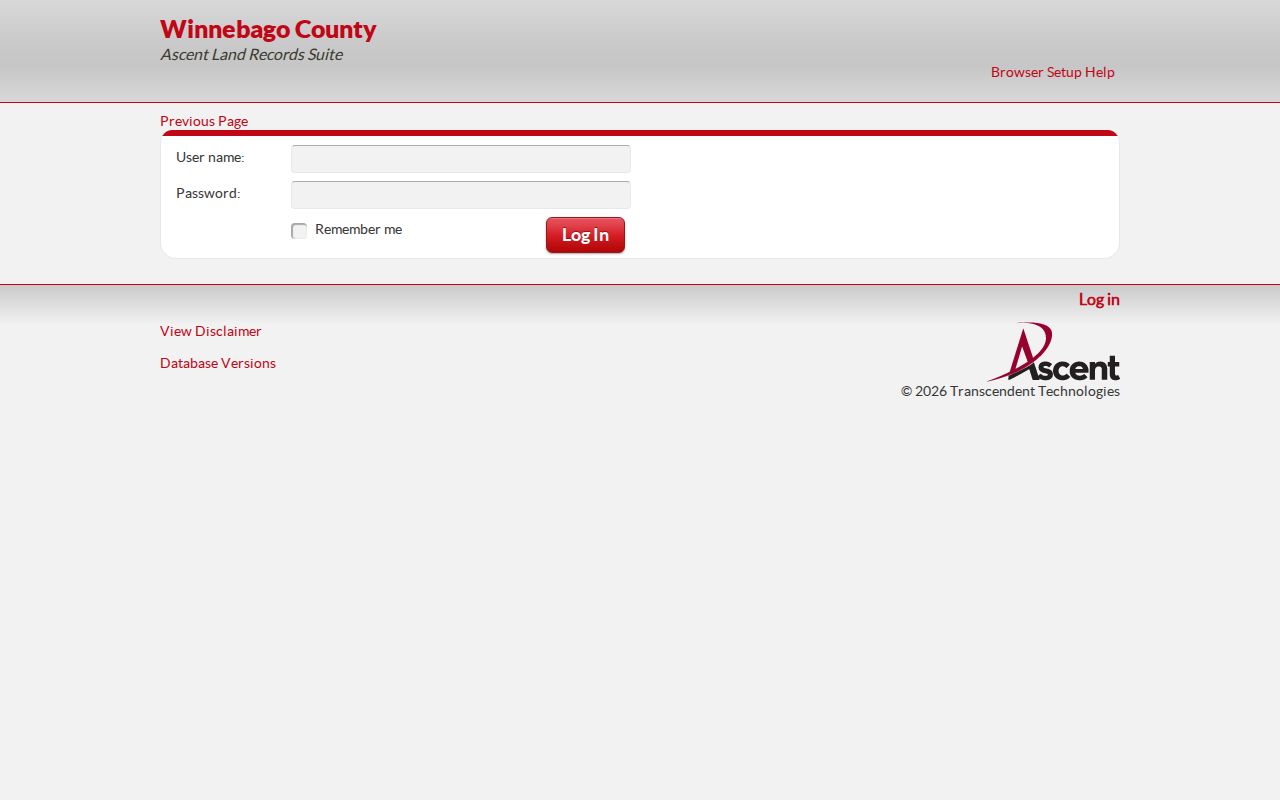
This image shows the Ascent search screen itself, before any parcel result is returned.
Winnebago County Situs and Mailing
The situs address is where the parcel sits. The mailing address is where tax bills and owner correspondence go. That second address may be a post office box, a company office, or a bank. It can also be a home outside Winnebago County entirely. Keep the two fields separate. That keeps you from mistaking a correspondence address for the property itself.
Streets also get renumbered, and some share names with other roads. Search the GIS map by address first, then confirm with the PIN and legal description. The Treasurer form splits street number, direction, name, and suffix into separate boxes. If an address fails, the map viewer also accepts a PIN or a municipality name.
Confirm a Winnebago County Deed Grantee
The tax roll tells you the name currently tied to a parcel. But a newly recorded deed can be more current than the roll. Search the Register of Deeds index by party name. Compare the legal description. Read the grantee field. County guidance says to leave the comma out of party-name searches. The online index and images generally begin in 1984. Older transfers may need an office or archive request. Direct Search gives basic index data without images. Tapestry is pay-as-you-go, and Laredo runs on subscription. For a confirmed present owner, the Winnebago County current owner record page explains how to weigh the roll against the latest deed.
Winnebago County LLC and Trust Owners
A Winnebago County parcel may name a trust. It may also name a company, personal representative, or other entity instead of a person. Search the exact grantee name shown on the deed. Wisconsin DFI's corporation search then shows a business entity's filed status. It also lists the registered agent, principal office, and filing history. A registered agent is a contact point, not necessarily the person who owns the land.
Estate transfers may surface as an executor deed. They can also take the form of an administrator deed, an affidavit, a transfer-on-death instrument, or another recorded document. Probate case summaries in Wisconsin Circuit Court Access add context. Still, the recorded land instrument is the record to compare against the parcel. A corporate filing and a court docket do not replace the deed.
The Wisconsin Department of Financial Institutions provides corporation and UCC search resources.
Winnebago County Roll Update Timing
No standard number of days separates a closing from a county or municipal roll update in Winnebago County. The county land-information plan describes parcel-maintenance schedules that vary. Municipal data is incorporated as it becomes available. A recent closing may show up in the deed index well before it reaches a tax or assessment display.
When dates or names disagree, compare the latest recording date, the parcel description, and the municipality before deciding which source is stale. Assume no fixed lag. The recorder's instrument and the assessor's update schedule answer different questions. Both concern the same parcel.
Winnebago County Property Fraud Alerts
Property fraud is a real worry for any owner of record. The Register of Deeds connects residents to a free Property Fraud Alert service. If a new recording touches a watched name, the service sends notice. The signup costs nothing. Treat an alert as a prompt, not proof. It flags a possible filing; it does not search the older chain of title. Check the document in the official land-record system. If the filing looks wrong, contact the county office. Wisconsin adds its own address protections. Safe at Home gives eligible participants a designated address. Judicial officers can request shielding of land-record websites through the county clerk under Wis. Stat. §757.07(4m)(b). So a different address may reflect a privacy process rather than a failed parcel match. Use the county-linked Property Fraud Alert service for notice of later recordings.
Protected Address Details in Owner Searches
A public owner result never tells the whole story. Wisconsin shields some personal details by law. The Safe at Home program gives eligible participants a designated address for covered public interactions. Judicial officers get their own shield. Under Wis. Stat. § 757.07(4m)(b), they can ask the county clerk to protect personal information. That protection applies to a public-facing land-record website.
Compare before you conclude. An owner name or mailing address may differ from an older record. Check the instrument date and the parcel description first. The person or parcel may not have changed at all. A privacy protection can hide a home address while title stays exactly where it was. Never try to rebuild a protected address from other sources. Have a legitimate records question? Ask the custodian how an eligible owner can use the formal protection process.
This distinction matters when you ask who owns this property. The tax roll pairs an owner name with a parcel number. It is not permission to identify or approach a household. Use the name and PIN to confirm the deed record. Never use either to find where someone lives.
Limits of Winnebago County Owner Searches
A Winnebago County owner search names the public owner of record for a parcel. That name may not be the occupant. It may not even be the person controlling an entity. A roll entry can go stale after a transfer. A name match can even point to a different parcel. Confirm with the legal description and the latest recorded deed. Neither a map nor an index is a title opinion.
Lawful use. Use owner information for lawful property research, civic review, and due diligence. Do not use public records to stalk, harass, intimidate, or harm another person.