
Winnebago County Property Tax Record Fields
Assessment facts and tax activity live separately. The Real Property Lister and municipal assessors maintain ownership, legal descriptions, values, and assessment information. Winnebago County property tax records stay useful because the Treasurer's inquiry connects each parcel to its charges and history. Field names vary by portal and municipality.
| Field | What It Shows | Where |
|---|---|---|
| Assessed value | Assessment figure used in the local tax roll | Ascent or municipal assessor |
| Estimated fair market value | Assessment estimate described in Wisconsin guidance | Assessment record or tax bill |
| Tax charges | Amount assessed for the tax year | Treasurer inquiry |
| Payments and delinquency | Payment status or balance information | Treasurer inquiry |
| Taxing jurisdiction | Local tax district allocation | Tax detail |
An assessed value is one measure. An estimated fair market value and a recent sale price answer different questions. The Department of Revenue explains how assessed values, market estimates, and assessment ratios relate. The parcel portal may scatter them. The tax page carries the bill and its payment trail. The assessment page shows how the parcel was valued.
Winnebago County Treasurer Search Fields
The Treasurer's form offers separate routes. A PIN search uses four segments. Street search splits number, direction, street name, and suffix; owner search takes last and first name; and the mobile-home number appears only when its checkbox is selected.
| Field | Type or format | Use |
|---|---|---|
| Parcel Identification Number | Pin 1, Pin 2, Pin 3, Pin 4 | Exact parcel lookup |
| Mobile Home | Checkbox | Switches to mobile-home search |
| Mobile Home Number | Text, when selected | Identifies the mobile home |
| Parcel Location | Number, direction, street, suffix | Address lookup |
| Owner’s Name | Last name and first name | Name-based parcel lookup |
| Search / Submit | Form controls | Runs the selected mode |
The Treasurer Parcel Tax Details Inquiry shows search and Search Again controls.
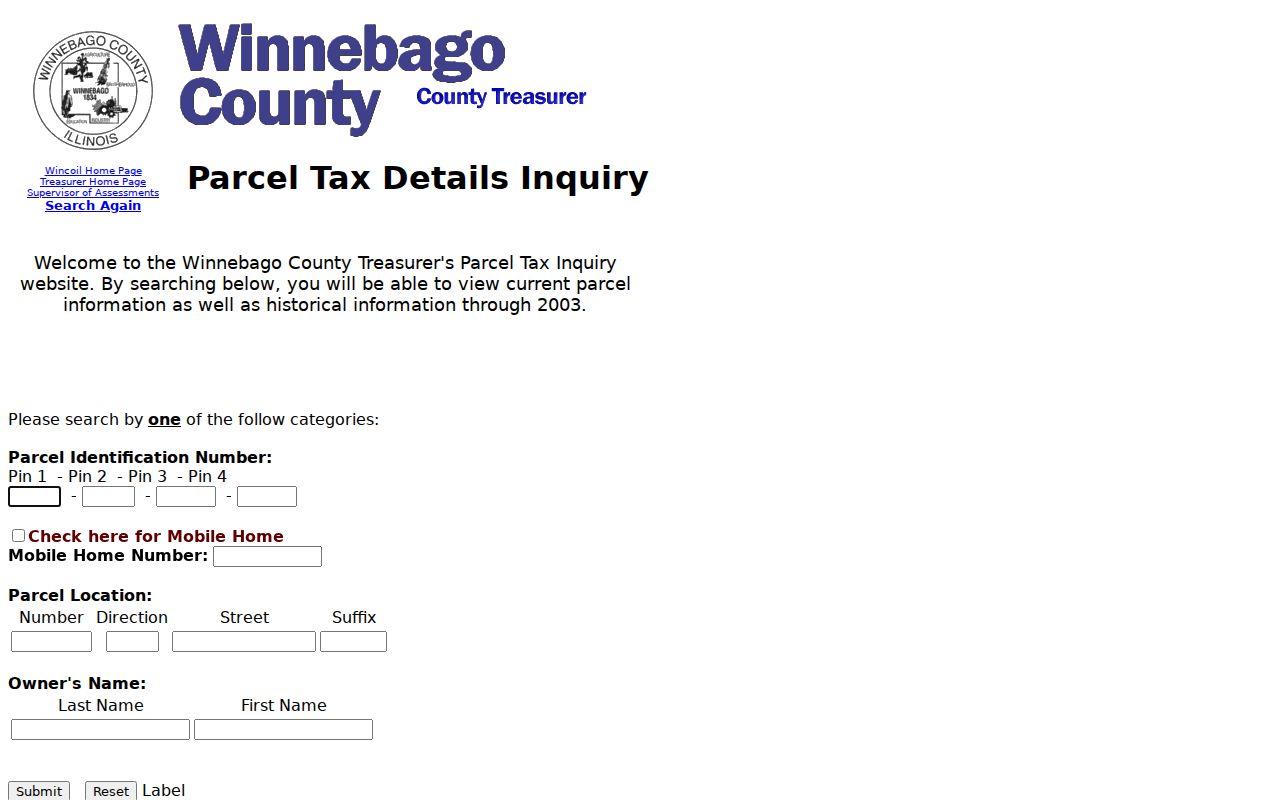
The Treasurer's live search page displays these same controls.
Looking Up a Winnebago County Tax Bill
Use the same parcel key everywhere. That keeps charges tied to the right lot when the Treasurer's system accepts PIN segments, street fields, mobile-home search, or owner name. The Ascent Land Records Suite links real-estate parcel information. Municipal assessor links vary by city.
- Search the Treasurer inquiry by PIN, address, owner name, or mobile-home number.
- Match the result to the parcel description and taxing jurisdiction.
- Read the tax-year charges, payment entry, and any displayed balance.
- Open the assessment source separately to review value and any listed flags.
- Assessed value
- The value recorded for assessment and local tax purposes.
- Equalized value
- A state value used to compare municipalities on a common basis.
- Assessment ratio
- The relationship between a municipality’s assessed values and market values.
- Delinquency
- A tax amount shown as unpaid in the tax record; verify its current status with the Treasurer.
Winnebago County Tax History to 2003
The Treasurer's TaxSearch reaches back through 2003. That reach helps trace charges and payment status. It is not a complete ownership history, though. A deed records a transfer; the tax inquiry follows balances and payments.
A past-due balance needs a second look. Check the parcel number and year, then contact the Treasurer through the county's official site for the current payoff. A public result can lag a payment that was just made or a later adjustment. Tax-sale publication, redemption terms, and sheriff-sale calendars change often. Treat the county's own site as the source for current versions rather than any older notice.
Municipal Assessors and the County Roll
Winnebago County's assessment trail is shared work. The Real Property Lister combines parcel IDs, legal descriptions, ownership, and values to support the final tax roll. Municipal assessors in Appleton, Menasha, Neenah, and Oshkosh handle the assessment work. Assessor links tied to a parcel differ by city. Ascent may point to the local system.
Two sources can disagree. Note whether each figure is an assessment value, a tax bill, or a map attribute, then check the municipality. Parcel geometry and assessment records refresh separately. The county land-information plan describes separate update paths for municipal parcels, so a small timing gap does not prove a record wrong.
The Ascent real-estate parcel search anchors the county's records. It is the county-linked starting point for property and tax detail.
The capture shows the public search entry point, not a parcel-specific assessment result.
Wisconsin Ratios and Equalized Value
Wisconsin's Department of Revenue publishes municipal aggregate ratios. The agency also explains why assessed value and equalized value are not interchangeable. An aggregate ratio compares a municipality's assessed roll with sales evidence. It shows the assessment level across that jurisdiction. It is not a parcel appraisal. It never corrects one home's value.
The 2026 property-owner guide covers current market value and assessment levels. It also walks through the Board of Review process. For a Winnebago County parcel, the municipal assessor's detail is the record to inspect. Department of Revenue reports add the wider municipal context. Compare the same municipality and report year when hunting a trend.
See the state's aggregate ratio reports and 2026 property-owner guide.
Charges, Payments, and Delinquency
Charges, payments, and delinquency are separate lines. A tax balance may lead to a sale or a court process. The county publishes no Winnebago-specific tax-sale list or redemption calendar. Never trust an old notice or a third-party summary as a payoff figure.
A distressed parcel deserves cross-checking. Compare the Treasurer's result with the Register of Deeds index for a tax deed or other recorded instrument, and check Wisconsin Circuit Court Access if a case may exist. Keep the parcel number and tax year consistent. That keeps every source tied to the same property. Confirm balances and redemption status with the Treasurer.
Exemptions Need a Local Check
Exemption and tax-credit flags only mean something when read against the right assessment records. They also need the right tax records. No complete Winnebago County parcel-card flag list exists. Municipal assessor pages differ. A blank field on a parcel profile does not prove ineligibility. A displayed flag is never a final decision on the exemption.
Start with the assessor contact listed on the parcel profile for that municipality. Follow the state's current guidance for the program in question. Remember that an assessment flag says nothing about occupancy. The tax bill, the assessment roll, and each state tax-credit program keep their own purpose. Each keeps its own record trail.
Appeal a Winnebago County Assessment
Assessment appeals in Wisconsin run through the municipal assessor and the local Board of Review. They follow Wisconsin Department of Revenue guidance. Notice dates and filing deadlines are set locally. No single countywide appeal calendar covers every Winnebago County municipality. Begin with the notice and the assessor link for the parcel's own municipality.
Check the property description first. Confirm the assessment year too. The number comes last. Keep the assessment record, the parcel description, and your market evidence in one file. Then follow the Board of Review instructions that currently apply. General process questions fit the state guide; hearing-date questions belong with the municipality.
Appeal window. Use the parcel municipality’s current Board of Review notice for filing dates and required steps. The state guide describes the process, but this research does not establish one Winnebago County-wide deadline.
2026 Wisconsin Sales Ratio Reports
The Wisconsin Department of Revenue announced final 2025 sales reports on March 24, 2026, pairing usable arm's-length sales with assessment-to-sales ratio analysis for assessors. Those outputs describe a municipality-wide assessment trend. They do not list every Winnebago County sale. Nor do they value one parcel.
Property tax records come first. Pull the parcel's assessment and tax-year detail. Match the local roll to the right report year and municipality. This keeps a countywide trend from standing in for one parcel's assessed value or sale price.
Context matters when reading a ratio. Keep the sales period, the municipality, and the ratio type beside the number, since a ratio compares assessments with qualifying sales in a reporting group. One purchase can carry odd terms or odd traits. It may skew a group badly. The state's summary tables help you ask whether an assessment level deserves a closer look, while property-specific talk belongs with the assessor and the local Board of Review. Use the parcel's current tax inquiry for bill and payment history, not a statewide ratio table.
Read the state's own words in the 2026 sales-report notice. The final report files are listed there.